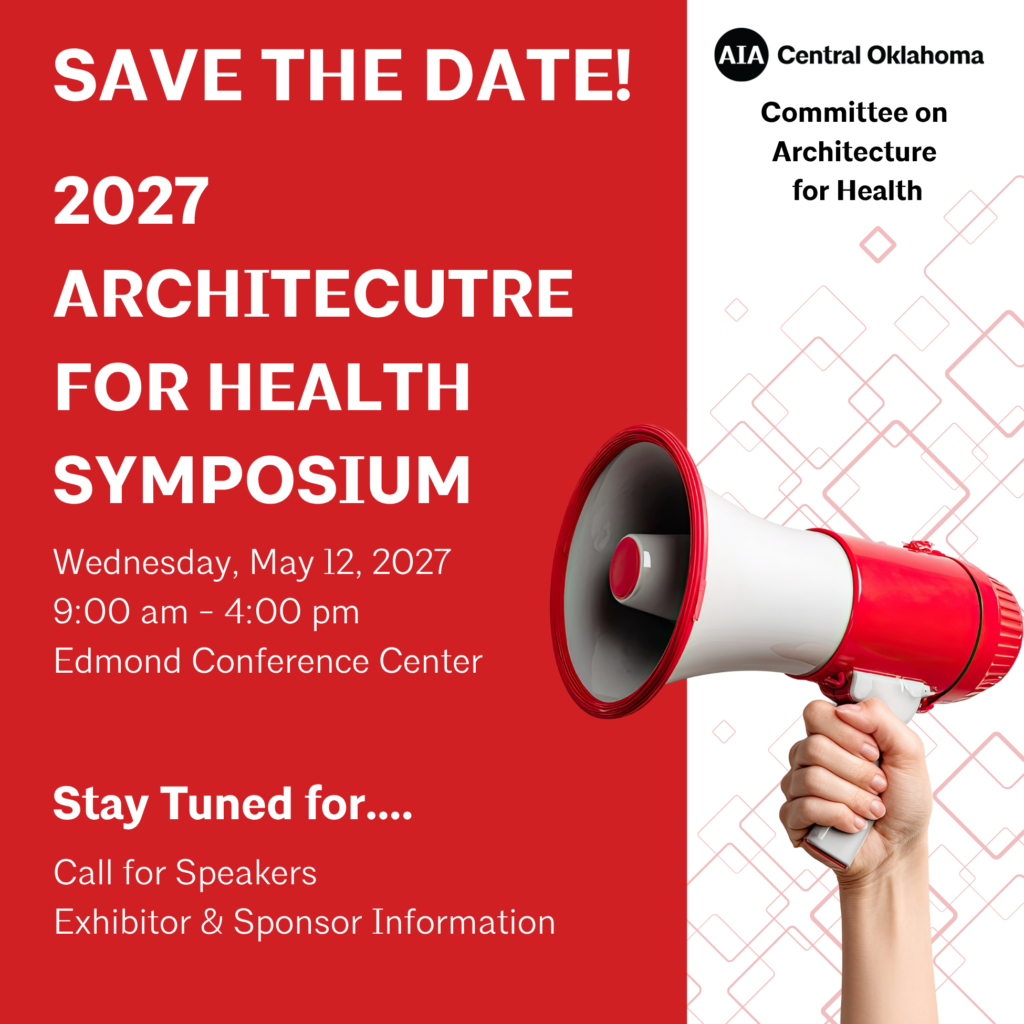
Healthcare Architecture Symposium

Join the AIA Central Oklahoma Committee on Architecture for Health for the Healthcare Architecture Symposium, a program dedicated to exploring current trends, challenges, and innovations shaping the design of health care environments. This event brings together architects, designers, and industry professionals for engaging presentations, valuable insights, and meaningful discussions focused on improving health care facilities and patient outcomes. Don’t miss this opportunity to learn, connect, and collaborate with leaders in health care design. Attendees will earn 5 hours of HSW credit.

Cost to attend: 
AIA Members: $45.00
Nonmembers:  $60.00
(please note, no refunds after April 14)

SCHEDULE

8:30 am
Registration

8:50 am
Welcome and Introductions

9:00 am
Built for Change: FGI’s Evolution from the Guidelines to the Code (1 HSW)
presented by Tina Duncan, AIA, ACHA, CBO of FGI and HKS

This session will explore key changes to the codes and FGI’s new approach to delivering standards, including updated publications, educational initiatives, and digital tools designed to improve access, interpretation, and enforcement. Led by three FGI leaders who guided this transformation, the program will provide an inside look at how these changes will impact the future of health care facility design.

Tina Duncan, AIA, ACHA, CBO (President)

Tina is a registered architect and expert in regulatory compliance for the design and construction of health care facilities, bringing more than 18 years of experience as a project architect and health care planner. She specializes in the technical aspects of health care design and has a deep understanding of how regulatory requirements shape the built environment, which led her to focus her career on health care building codes. At HKS, she provides firmwide technical and regulatory project reviews and leads educational seminars on code and compliance. Tina also chairs the Codes and Standards Committee for the AIA Academy of Architecture for Health and the Dallas AIA Codes and Standards Council and is a member of the International Code Council and the National Fire Protection Association. She served on the 2022 FGI Health Guidelines Revision Committee and was a subject matter expert for the 2018 Guidelines for Design and Construction of Outpatient Facilities.

10:00 am 
Circadian Rhythm (1 HSW)
presented by Robert Soler of Bios Lighting

Circadian supportive lighting is an innovative approach to lighting design. However, traditional lighting practices often require very high light levels and energy consumption to meet the standards outlined in RP-46-25. This session will delve into the design parameters necessary to meet the requirements of RP-46-25 and introduce a formula for achieving this standard, known as application efficiency. This will provide practical insights for professionals implementing circadian lighting. It is essential to recognize that measuring circadian supportive lighting differs from measuring conventional lighting. It is crucial to consider the role of color and spectrum, as different light colors and spectrums impact circadian rhythms.

Robert Soler

Robert Soler, with Bios Lighting, is a leading expert in circadian lighting and its impact on human health and performance. He has served as a subject matter expert for NASA and advised organizations such as the Los Angeles Dodgers and the U.S. Olympic Ski and Snowboard Team on strategies to combat jet lag. Through a National Science Foundation fellowship, he researches circadian rhythms and collaborates with the National Institutes of Health on related studies. He has also partnered with Cincinnati Children’s Hospital to develop specialized lighting for NICUs, improving outcomes for premature and newborn babies. Recently, he received a grant from the U.S. Department of Energy for his work on circadian lighting strategies in retrofit applications.

11:00 am
Intro to Healthcare Codes (1 HSW)
presented by Michael Turner, AIA, NCARB, DBIA of HFG Architecture and Kelsey Cromaz, AIA of REES

This session will be a high level introduction of the codes and standards that are unique to healthcare design. In this brief introduction, we will explore the complexities and approach to healthcare code compliance.

Michael Turner, AIA, NCARB, DBIA 

Michael Turner is the Director of Quality Assurance at HFG, specializing in healthcare codes, regulations, and emerging compliance trends. A member of IIBEC, his background in building enclosure consulting and multi-jurisdictional permitting across the U.S. provides a deep understanding of the complexities inherent in healthcare project design. Michael is passionate about delivering high-quality, compliant facilities that support safe, effective, and resilient care environments.

Kelsey Cromaz, AIA, LEED AP

Kelsey Cromaz is a Senior Associate and Project Manager at REES. A licensed architect with more than 15 years of experience. Kelsey is recognized for her technical proficiency and her ability to lead clients through the complexities of the healthcare design process. Kelsey’s healthcare portfolio spans a wide range of project types and her experience navigating the regulatory, code, and operational complexities of healthcare construction makes her a valued resource on projects that demand both technical rigor and a patient-centered design approach. She is a member of the American Institute of Architects, a LEED Accredited Professional, and serves on the Cystic Fibrosis Foundation Young Professionals Board and the Urban Land Institute Oklahoma Chapter.

12:00 pm 
Networking Lunch

Join us for a networking lunch where attendees can connect with fellow healthcare architects, designers, and industry professionals. This is a great opportunity to exchange ideas, build relationships, and explore the latest products and services from our exhibitors supporting health care design. 

1:00 pm
More Information Coming Soon!

2:00 pm
How the Built Environment affect Patient Care and Satisfaction (1 HSW)
presented by Tina Duncan, AIA, ACHA, CBO of FGI and HKS

The design of healthcare environments plays a critical role in shaping patient outcomes, staff efficiency, and overall satisfaction. This session will explore how the built environment influences patient care through factors such as layout, lighting, acoustics, infection control strategies, and access to natural light and nature. Drawing on guidance from the Facility Guidelines Institute (FGI) and real-world healthcare examples, the program will examine how thoughtful design decisions can improve patient experience, support caregiver performance, and promote healing environments. Attendees will gain practical insights into how evidence-based design and regulatory guidance can be applied to create healthcare spaces that enhance safety, comfort, and quality of care.

Tina Duncan, AIA, ACHA, CBO (President)

Tina is a registered architect and expert in regulatory compliance for the design and construction of health care facilities, bringing more than 18 years of experience as a project architect and health care planner. She specializes in the technical aspects of health care design and has a deep understanding of how regulatory requirements shape the built environment, which led her to focus her career on health care building codes. At HKS, she provides firmwide technical and regulatory project reviews and leads educational seminars on code and compliance. Tina also chairs the Codes and Standards Committee for the AIA Academy of Architecture for Health and the Dallas AIA Codes and Standards Council and is a member of the International Code Council and the National Fire Protection Association. She served on the 2022 FGI Health Guidelines Revision Committee and was a subject matter expert for the 2018 Guidelines for Design and Construction of Outpatient Facilities.

3:00 pm

Who’s that New Design Team Member? The Changing Role of the Equipment Planner
presented by Gloria Cascarino

The role of the Equipment Planner has changed dramatically in the last few years – whether they are in-house at a hospital or consultant-based. Previously, a list-taker and specifications-provider, they now must forecast technology solutions, create and maintain solid budgets, facilitate group interaction, and work more closely with all members of the design and construction team. Join us as Gloria Cascarino shares how these new roles challenge typical thinking and support design in a whole new (better!) way. We’ll offer proven solutions and processes, and even some “Ah-Ha Moments”. See you there!

Gloria Cascarino

After 20 years’ experience in Hospital Operations and Materials Management, Gloria led Equipment Planning Services for a national Design Firm for 15 years. She is now the Vice President of Equipment Planning at Partners Healthcare Group. An expert in emerging technology and budget compliance, she’s planned equipment for all types of healthcare clients and projects – from minor renovations to replacement hospitals. She has a special interest in equipment’s impact on the Environment of Care, patient outcomes and satisfaction. She collaborates with clinicians and design professionals to forecast technology needs, maximize the use of existing equipment, and make prudent spending decisions. Her on-site hospital experience provides a unique perspective for project management, patient satisfaction and safety, regulatory requirements, and staffing concerns. She is respected for her expertise, attention to detail, responsiveness, and collaborative style.

4:00 pm 
Thank you for attending!

Scroll to Top